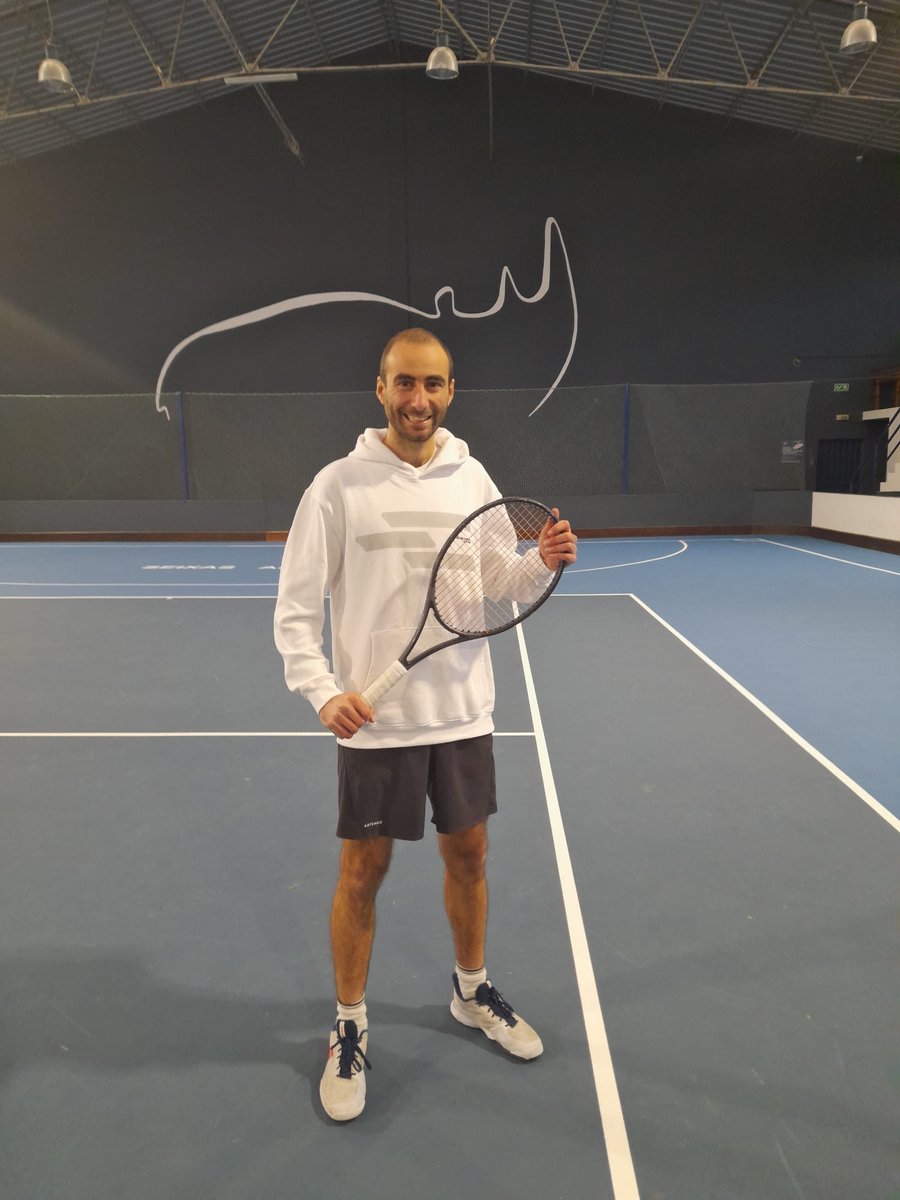
Hello, my name is Ricardo. I am a tennis coach based in Caminha, Portugal.
I started playing regularly in 2020, during COVID, because I wanted a safe way to exercise while football was unavailable. I joined a group lesson and, for a while, felt as if I was improving. The balls arrived where I expected them, my strokes looked better, and the corrections made sense inside the practice.
Then I began playing matches and was repeatedly beaten heavily. Opponents gave me slices, drop shots, serves, changes of rhythm, and situations I had barely encountered. Practice had made me feel competent, but the match seemed to be asking me to play a different game.
Learning to investigate my own game
That contradiction made me curious. I filmed matches, researched ideas, tried different grips, changed the way I served, explored almost every style of play, and began using matches as places to experiment. Sometimes an idea helped. Often it did not. But the experiments were mine, and that made me pay attention differently.
I also became less satisfied with simple explanations. An "unforced error" often had a history several balls long. A stroke that worked during feeding could disappear as soon as movement, choice, and pressure returned. I began asking not only what my movement looked like, but what I was trying to do, what I had noticed, and what the opponent had made possible.
My coach did something for which I remain grateful: when I asked to bring exercises or spend time exploring, he gave me room. He did not create my curiosity, but he did not close it down.
Finding the language later
When I later studied coaching, I encountered player-centred approaches and ecological dynamics. These ideas helped me understand learning as something that emerges through the relationship between the player, the task, and the environment. They gave me language for why practice connected to real problems, opponents, perception, and decisions had taught me so much.
The theory did not arrive first and tell me how to learn. The game gave me questions first. The theory helped me understand them later.
The freedom to keep questioning
Curiosity was only part of this path. I have also been fortunate. Software engineering pays my bills, so coaching does not need to make itself commercially indispensable. I work independently in a small village, outside much of the pressure to reproduce an established club method.
That freedom does not make my choices automatically correct. It simply makes it easier to admit uncertainty, test ideas, and try to do what feels most responsible for the player, even when progress is slower or less visible.
A coach can contribute knowledge, questions, people to play with, and a better environment. The learning still belongs to the player.
Why Discovering Tennis exists
Tennis gives me genuine joy, and because I care about it deeply I want to keep examining how people enter it, learn it, compete in it, and build a relationship with it.
This blog follows the same process that changed my own tennis: experience creates questions, research offers possible explanations, and writing helps me examine them without pretending they are final answers.
How I Coach
I coach the way I do because I believe people learn best when they are engaged, listened to, and involved in their own learning. When they feel safe enough to explore, experiment, make mistakes, and try again. That is the kind of environment I try to create on every court.
You have the right to ask why we are doing something, what I believe it may help with, and what its limitations are. Parents have the right to understand and observe the environment their children enter. I may ask people outside a session not to call instructions onto the court, but I should be able to explain that boundary and the reasoning behind my coaching.
Player-centred
Starting from the player in front of me: what they feel, what they want to improve, and what problems they are trying to solve.
Evidence-informed
Using research on skill learning to design sessions that are connected to how tennis is actually played.
Ecologically trained
Creating practice environments where players can perceive, decide, adapt, and discover solutions that work for them.

Planeta Ténis was born from a simple wish: that every child has the opportunity to discover what tennis can give them.
A project promoting tennis for children and families — we bring the game to nurseries, schools and community spaces, creating positive and fun first experiences. The goal is simple: more children discover tennis and want to come back.
Visit Planeta Ténis